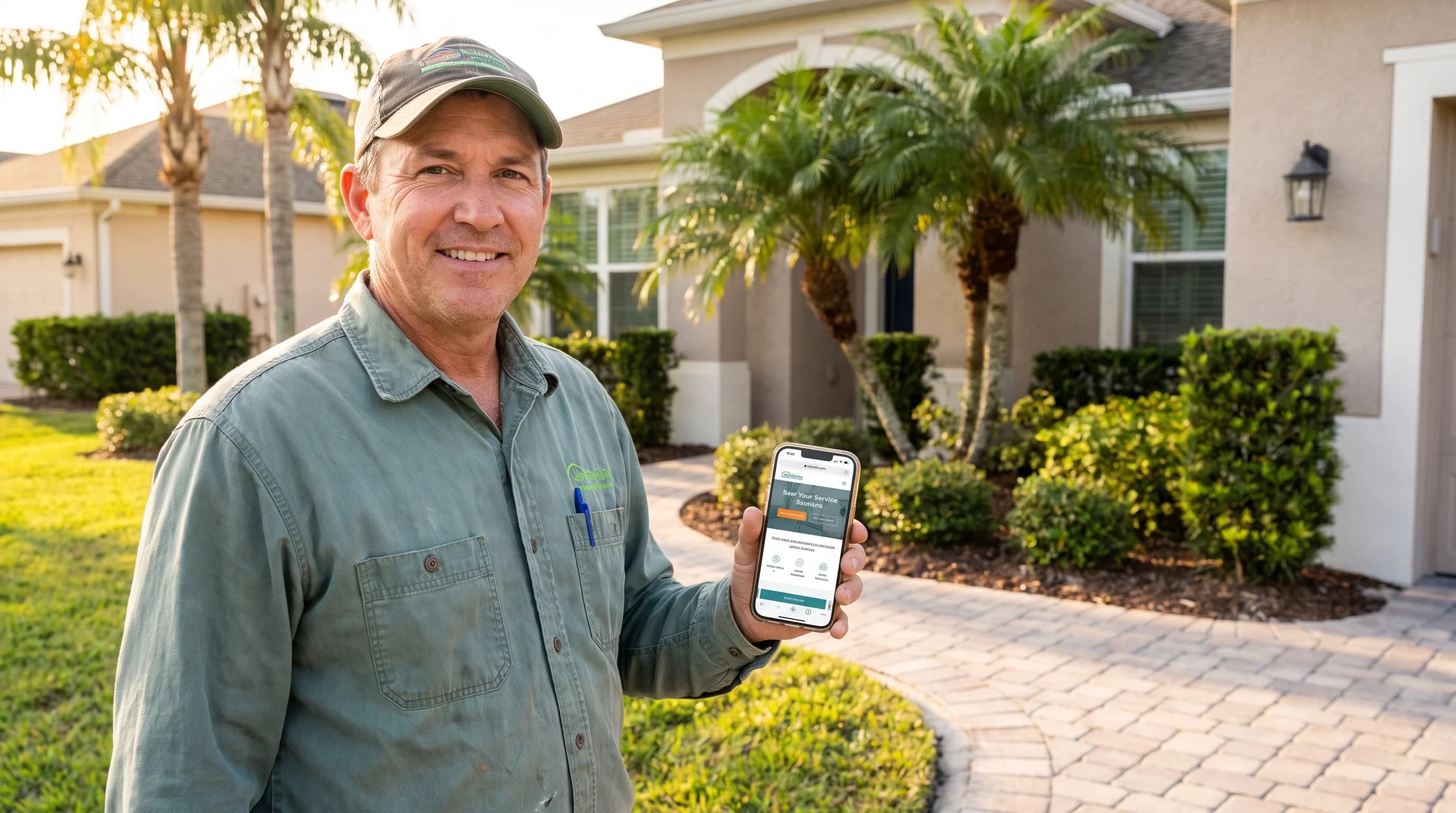
More contractors lose jobs to a good-looking website than to an ugly one.
That sounds backward, so let it sit for a second. A homeowner with a fallen limb across the driveway or a cracked patio does not care whether your site won a design award. They care about three things: do you do this kind of work, do you cover my area, and can I trust you enough to call. A slick site that hides the phone number behind a slow animation answers none of those. A plain one that puts a tappable number and real photos on the first screen answers all three.
Good contractor website design is not an art project. It is a sales tool judged by exactly one number: how many visitors turn into booked jobs. This post walks through what actually moves that number, in the order worth fixing, for owners of tree, landscaping, hardscaping, irrigation, and outdoor living businesses.
Design for the phone in a homeowner's hand
Your traffic is not sitting at a desk. It is a homeowner standing in the yard, or on the couch after a storm, deciding who to call next. Google has indexed the web mobile-first for years, which means it looks at the phone version of your site to decide how you rank. Google's own mobile-first indexing guidance is blunt about it: the mobile experience is the experience.
So the test for every page is simple. Pull it up on your own phone. If you have to pinch, zoom, or hunt for the phone number, so does every customer.
Three things matter most on mobile:
- A tappable phone number on the first screen. Not in the footer. Not behind a menu. Top of the page, one tap to dial.
- Big touch targets. Buttons a thumb can hit without zooming.
- Readable text without pinching. If they have to zoom to read your service list, you have already lost half of them.
Speed is a feature, not a nice-to-have
A beautiful site that takes six seconds to load is a slow site with nice pictures. On a phone, on cell data, in a yard with two bars, every extra second bleeds visitors who bounce back to the search results and call the next company.
Google turned this into a measurable standard called Core Web Vitals - loading, responsiveness, and visual stability. Its guide to Core Web Vitals explains the thresholds, and page speed feeds directly into how Google ranks and surfaces your pages through its page experience signals. Faster is not just friendlier. It is a ranking input.
The usual speed killers on contractor sites are heavy, uncompressed hero images, a pile of plugins, and auto-playing video. You do not need any of that to book a tree job. You need it to load before the homeowner's patience runs out.
Answer the trust question with proof, not adjectives
Every homeowner is quietly asking, "Can I trust these people in my yard, near my house, with my money?" Words like "professional," "reliable," and "trusted" do nothing to answer that, because every competitor uses the same three words.
Proof answers it. And because Tree Revenue is a young company, the honest kind of proof to build first is not testimonials you do not have yet. It is:
- Real photos of your own crews and finished work. Before-and-after shots of a removal, a paver patio, an irrigation install. Your work is the best salesperson you have.
- Your Google reviews, shown on the page. If you have earned reviews, surface them. If you are still building them, put a review system in place - we covered how in our guide to review generation for home services.
- Specifics that signal competence. Licensed and insured, the equipment you run, the neighborhoods you serve, how fast you respond to emergencies.
Do not invent numbers or quotes. A single honest before-and-after gallery outperforms a wall of vague claims and fake five-star badges, and it is the kind of thing a homeowner actually screenshots and shows their spouse.
Make the next step obvious and singular
A confused visitor does nothing. If your homepage offers a phone number, a contact form, a quote request, a newsletter signup, and a live chat all at once, you have given the homeowner a decision to make instead of an action to take.
Pick the primary action - almost always "call now" for emergency and high-ticket work - and make it the loudest thing on the page. Offer a simple form as the backup for people who cannot talk right then. That is it.
This matters most for the trades where the job is urgent or expensive. A homeowner staring at a split oak wants to call a real person, so a website built to funnel storm and removal calls into your phone beats a clever contact form every time. A hardscape buyer comparing patio companies wants to see your gallery and then reach you easily, which is exactly what a conversion-focused site for hardscape and outdoor living contractors is for.
The part most redesigns miss: what happens after the click
Here is the trap. Owners spend on a redesign, the new site looks great, and leads still feel flat. Why? Because the website was never the whole funnel. It is the front door. What happens after someone calls or fills out the form decides whether the design pays for itself.
Two leaks quietly cancel out good design:
Missed calls. A new site that finally makes people call is worthless if half those calls ring out during a busy install day. The fix is a system that catches every call and texts back the ones you miss, which we broke down in missed-call text-back for contractors.
Slow or no follow-up. The company that responds first usually wins the job, and most never respond fast. That is not a design problem, it is an operations one, and it is why speed to lead decides who wins the job.
This is the honest reason a redesign alone rarely moves revenue. A website is the Foundation layer of a working system, not the whole thing. A complete growth system that captures, tracks, and follows up on every lead is what turns a good-looking site into booked jobs. If you want to see where the website sits and what a full setup runs, the transparent pricing packages lay it out.
Do not forget the plumbing you cannot see
A few unglamorous basics separate a site that ranks and gets found from one that sits invisible:
- Real service pages. One page per core service, not everything crammed onto the homepage. This is also how you show up for specific searches, which we covered in how local SEO works for service businesses.
- Local signals. Your city and service areas in the actual text, and a Google Business Profile that matches. Google leans on both, and its local ranking guidance rewards consistency between your site and your profile.
- Call tracking. If you cannot tell which calls came from the site, you cannot tell if the design is working. Set up call tracking so you know which channel books jobs.
None of this is visible in a design mockup, which is exactly why it gets skipped and why so many pretty sites underperform.
Your website fix-it list for this week
You do not need a full rebuild to move the number. Do these four things before Friday and most contractor sites get measurably better:
- Open your site on your phone and time the load. If it drags, compress or remove your biggest images today.
- Put a tappable phone number on the first screen of your homepage and every service page. One tap to dial, no scrolling.
- Add three real before-and-after photos of recent jobs to your homepage, with honest captions. No stock images.
- Test your own funnel. Call and form-fill your business from an outside number, and fix whatever does not get answered fast.
Good contractor website design is not about winning a beauty contest. It is about a homeowner in your service area confirming, in a few seconds on a phone, that you are the right company and reaching you before they call anyone else. Get the phone tappable, the pictures real, the site fast, and the follow-up instant, and the design has done its only job.