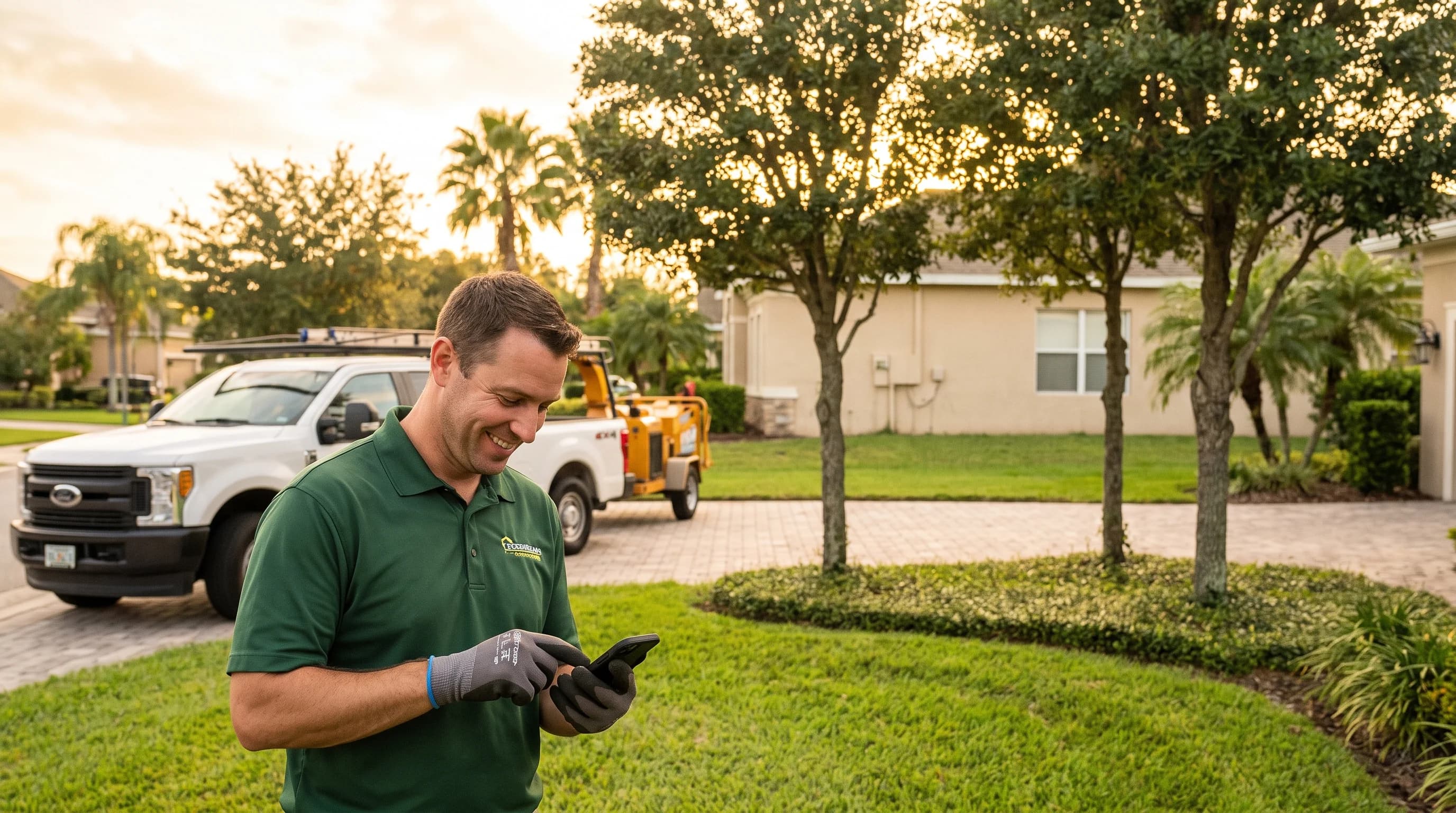
The tree company with 400 reviews is not winning your market. The one quietly adding a fresh review every few days is.
That flips how most owners think about reviews. The usual assumption is that reviews are a trophy shelf: pile up enough over the years and you win. In reality, a giant lifetime total that stopped growing last spring does almost nothing for you today. A smaller, steadily growing count beats it, in the map rankings and in the mind of the homeowner reading them.
So review generation for home services is not a one-time push to hit some number. It is a habit you run after every job, forever. Get the habit right and you climb the map, earn the click, and book more of the calls you are already paying to attract. This is how to build it.
Why velocity beats volume
Two signals matter to a homeowner scanning Google for a tree service or an irrigation repair: how many reviews you have and how recent they are. The recency half is the one owners underrate.
Put yourself in the buyer's seat. A profile with 60 reviews where the newest is from last week reads as a busy, active company. A profile with 300 reviews where the newest is 14 months old reads as a company that had its moment and maybe faded. The homeowner cannot see your calendar, so the date of your last review is the proxy they use for "are these people still good, still around, still busy."
Google's local ranking leans the same direction. Local SEO researchers consistently report that a steady flow of recent reviews correlates with stronger map-pack placement than a stale pile does, and that going weeks without a single new review tends to soften rankings. Treat specific percentages you see quoted online as illustrative rather than gospel, but the direction is well established: fresh reviews are worth more than old ones.
The practical takeaway is simple. You are not trying to reach 100 reviews and stop. You are trying to never go a week without a new one. That is a completely different behavior, and it is one you can actually build into how your crews work.
The one mistake that keeps your count flat
Here is the pattern that stalls almost every home service company: they ask for reviews when they remember, which is roughly never.
The job wraps, everyone is tired, the crew is already thinking about the next stop, and the review ask evaporates. A week later the owner notices the count has not moved and fires off a batch of awkward "hey, would you mind..." texts to customers who have half-forgotten the job. Response rates are terrible, so the owner concludes customers just do not leave reviews, and gives up.
The customers were never the problem. The timing and the consistency were. When you ask a happy homeowner in the moment, right as they are looking at the cleared yard or the sprinklers finally working, a large share say yes. When you ask a week later by memory, almost nobody does.
Build the ask into the job, not your memory
The fix is to make the review request a step in the job, the same way you already treat cleanup, payment, and loading the truck. It happens every time because it is on the list, not because someone felt like it.
Google itself encourages the direct ask. Its tips to get more reviews recommend reminding customers to leave a review and handing them an easy path in, like a short link or a QR code. So this is not a gray-area growth hack. It is exactly what the platform tells you to do. The job is to make that ask automatic.
Three things make the ask land:
- Ask in the moment. The best window is before the crew leaves or within a few hours, while the result is right in front of the customer. For same-day tree, irrigation, or lawn work, that is the same day, not next week.
- Ask by text. A text with a direct link to your Google profile gets opened and tapped far more than an email that lands in a crowded inbox. Make the link go straight to the review box so there is nothing to hunt for.
- Ask twice. Most people who mean to leave a review get distracted before they finish. One friendly follow-up a couple of days later to the folks who did not respond recovers a real chunk of them. Stop at one ask and you leave half your reviews on the table.
None of this requires a marketing team. It requires deciding that the review ask is part of the job and then making sure it happens on every ticket, not the ones you happen to remember.
Make it run without you
Reading "do it after every job, twice, by text" and actually doing it 200 times a month are different problems. The first is a good intention. The second is a system, and this is where most owners need help.
The version that survives a busy season is automated. When a job is marked complete, a text goes out with the review link. If the customer has not left a review in two days, a second gentle nudge fires on its own. You are not standing over anyone reminding them, and it does not slip when you are slammed in July. Wiring that kind of after-the-job automation so it runs whether or not you think about it is a core part of our growth system for home service companies, because a review engine that depends on human memory is a review engine that stalls.
The same plumbing that sends review requests is the plumbing that answers missed calls and follows up on quotes. That is why reviews are not a standalone tactic but one piece of a pipeline, and why our transparent packages and pricing are built around the whole flow rather than a single trick. A tree service that automates reviews the same way it automates its follow-up ends up with both a fuller map ranking and a fuller calendar.
Turn your reviews into more than a number
Getting the reviews is half the job. Using them is the other half.
Reply to every review, good or bad. A short, specific thank-you on a positive review signals to the next reader, and to Google, that a real business is paying attention. A calm, professional response to a negative one often matters more than the complaint itself, because prospects watch how you handle problems more closely than how you handle praise.
Put your best reviews to work off the profile too. Real customer quotes belong on your service pages and your storm or emergency landing pages, where a nervous homeowner is deciding whether to call. If you run a tree service, that credibility does heavy lifting on a page like our tree service growth page, where the buyer is often making a fast, high-stakes decision about who to let onto their property.
The one number to watch
If you track a single review metric, make it reviews added per month, not reviews total. Total is a vanity number that only goes up and tells you nothing about momentum. Reviews per month tells you whether your system is alive.
Check it the same way every month: open your Google Business Profile, count the reviews dated in the last 30 days, and write that number down. If it climbed or held steady, your after-job ask is working. If it dropped, your crews quietly stopped asking, and you can fix it this week before your ranking feels it.
That is the whole discipline. Not a heroic push to 500 reviews, but a steady drip that never dries up, driven by an ask that happens on every job instead of when you remember. Nail the rhythm and your review count stops being a scoreboard of the past and becomes the engine that keeps you at the top of the map and on the phone with your next customer.