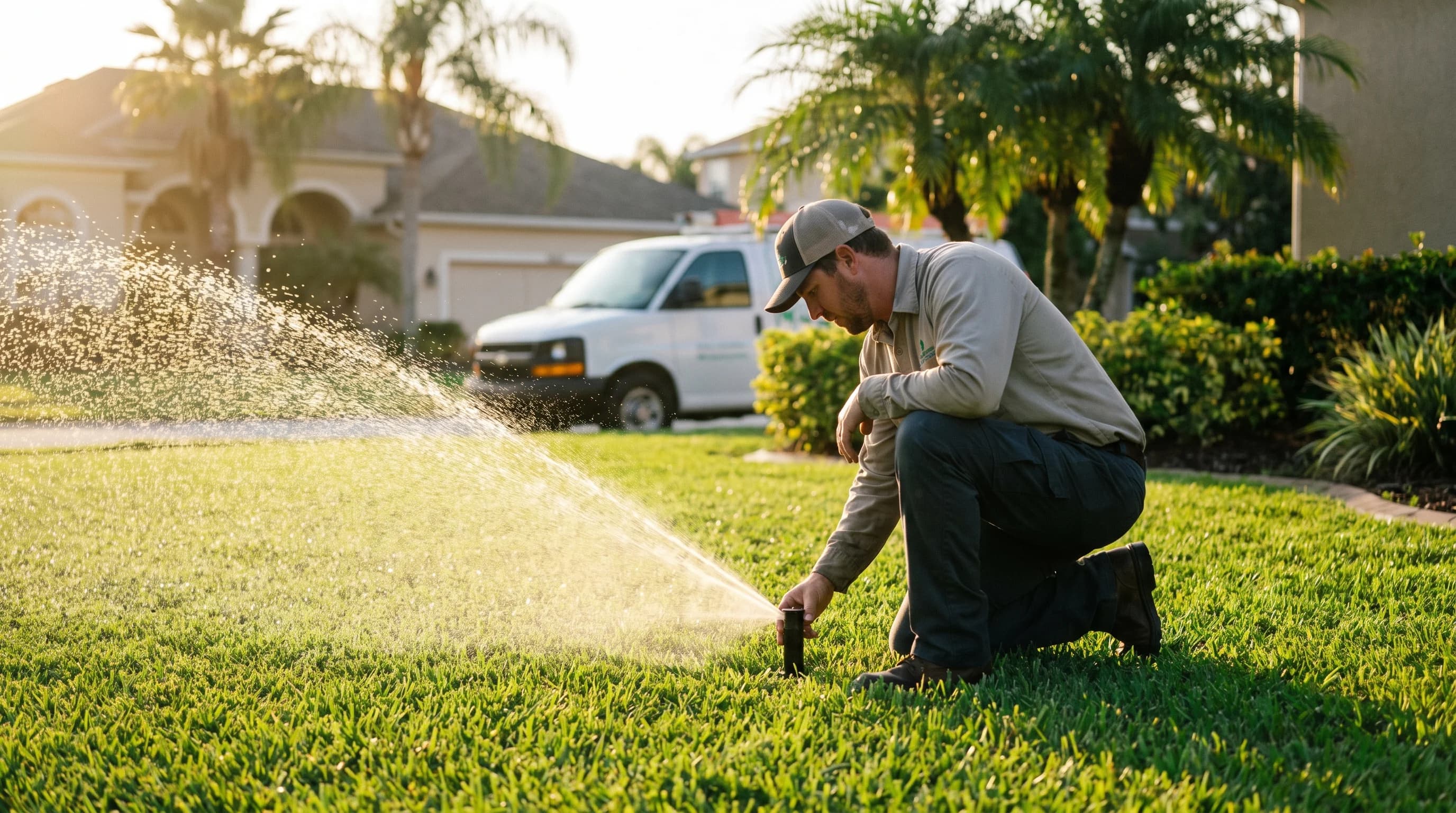
More repair calls will not build you a stable irrigation business. That sounds backwards, because repairs are how most sprinkler companies make their money. But a business that lives on repair calls lives on the phone ringing, and the phone goes quiet the moment the weather turns mild or a competitor answers faster. You are always starting from zero.
The companies that get off that treadmill do it with irrigation maintenance contracts. A repair is a transaction. A maintenance contract is a relationship you get paid for, on a schedule, whether or not anything breaks. This guide covers what those contracts are, the math that makes them worth more than the repair itself, and the one thing most companies get wrong: how to actually sell the plan while you are still standing in the yard.
Why repair-only revenue keeps you stuck
Repair work has three problems baked in. It is unpredictable, so you cannot plan a schedule or a payroll around it. It is competitive on speed, so you win or lose on who answers the phone first. And it ends the second the job is done - you have no claim on that customer until the next thing breaks, which might be next year or never.
A maintenance plan fixes all three. You know how many visits are on the calendar. You are the default provider, not a name they re-Google in a panic. And you have a reason to be back on that property two or three times a year, every year.
What an irrigation maintenance contract actually is
Strip away the jargon and a maintenance contract is a written promise to perform a defined set of services on a schedule, for a fixed fee. For most sprinkler companies that breaks into a few common shapes.
Seasonal service plans bundle the predictable visits every system needs: a spring startup and system check, a mid-season inspection, and a fall shutdown. Each visit has a checklist - test each zone, clean and adjust heads, check the backflow preventer, look for leaks, and program the controller for the season.
Tune-up plus repair-discount plans pair those visits with a standing discount on any parts and labor for problems found during them. The customer feels smart for being covered, and you get first crack at every repair on the property.
Efficiency and upgrade plans lean on the fact that an aging clock timer wastes water. The EPA notes that replacing a standard clock-based controller with a WaterSense labeled irrigation controller can save an average home up to 15,000 gallons of water a year. A maintenance plan is the natural place to recommend and install those upgrades over time.
You do not need all three. Start with one clean seasonal plan and add tiers later.
The math: a plan is worth more than the repair
Here is the shift in thinking. A single repair might be a $150 to $400 ticket, one time (illustrative figures - use your own). A maintenance customer on a two- or three-visit plan pays you every year, sends you the repairs in between, and stays for years. The lifetime value is not close.
Recurring plans also do three things a pile of one-off invoices cannot:
- They smooth your cash flow. Booked visits mean a schedule you can staff and a slow month you saw coming.
- They raise the value of your company. Anyone who has looked at buying a service business will tell you predictable maintenance revenue is worth far more than one-off install or repair income. A book of contracts is an asset.
- They lower your marketing cost per job. You already paid to win this customer once. Keeping them on a plan is cheaper than buying the next stranger. That is the same logic behind owning your lead pipeline instead of renting sprinkler repair leads - the money is in what happens after the first job.
How to sell the plan (the part everyone skips)
Most advice on irrigation maintenance contracts stops at "offer a plan." The hard part is the sale, and the best moment for it is one you are already paying for: the repair visit itself.
You are on the property. The system is opened up. You have just proven you know what you are doing. The customer trusts you more in that moment than they ever will from a postcard. Use it.
A simple point-of-service pitch sounds like this:
While I had the system open, I noticed two heads starting to go and a valve that will need attention within the year. A maintenance plan would catch things like that at the spring visit, before they turn into a flooded flower bed in July. I can put you on one before I leave - it is two visits a year plus a discount on anything we find. Want me to set it up?
That is it. No brochure, no follow-up call three weeks later when they have forgotten your name. Enroll them on the spot on your phone. Enrolling on the spot beats any postcard, because you are asking when the value is fresh and the trust is highest.
What to put in the agreement
A vague contract turns into unlimited free service calls. A clear one protects both sides. Cover at least these:
- Exact visits and scope. List each visit, the season window, and what the checklist covers.
- Response time. What priority do plan holders get for covered repairs? A same-week promise is a real selling point.
- Included vs billed. Be explicit about what the plan fee covers and what gets billed separately, so parts and major repairs are never a surprise.
- Price and payment. The annual price and how it is paid - up front, or split across visits.
- Annual price adjustment. A short clause letting you raise the rate a set percentage each year keeps a multi-year plan from eroding as your costs rise. Many contractors tie it to the Consumer Price Index published by the Bureau of Labor Statistics so the increase is transparent and defensible.
- Renewal terms. How and when it renews, and how either side cancels.
Signaling credentials helps here too. If you or your techs hold the Irrigation Association's Certified Irrigation Contractor credential, say so in the agreement and on your site - it tells the customer the plan is run by professionals, not a guy with a truck.
The follow-up system that makes renewals stick
A contract is only recurring if it actually renews, and renewals are where busy owners leak money. The plan expires, nobody calls, the customer drifts, and next spring they hire whoever answers first.
The fix is a system, not a sticky note. Every plan needs a renewal date, an automated reminder before it lapses, and a booked spring visit that gets scheduled without you thinking about it. This is the same follow-up discipline that turns quotes into jobs, and it is exactly what a growth system built to capture and follow up on every customer is for - so renewals and re-books happen on autopilot instead of relying on you to remember.
If you are building your irrigation company around recurring revenue rather than one-off calls, this is the operating system underneath it. Our growth approach for irrigation and sprinkler companies is built to keep the schedule full and the maintenance book renewing year after year.
The Central Florida angle
In much of the country irrigation is seasonal, so plans sell on winterization. In Central Florida the pitch is different and, if anything, stronger: the growing season never really stops, systems run most of the year, and water rules are strict.
The St. Johns River Water Management District, for example, limits most landscape irrigation to two days per week during daylight saving time and fewer during shortages. A homeowner who waters on the wrong day or runs an inefficient controller risks fines and wasted money. A maintenance plan that keeps the controller programmed to the current schedule and the system running efficiently is not a nice-to-have here - it is how customers stay compliant and keep their landscape alive through a Florida summer.
That is a story worth telling on every repair visit and every service page.
Your maintenance-contract checklist for this week
You do not need a new CRM or a rebrand to start. Do these four things before Friday:
- Write one plan. Two seasonal visits, a clear checklist, a repair discount, one annual price. Keep it to a single page.
- Build the pitch into your repair visits. Train every tech to point out what they noticed and offer the plan before they leave, with a way to enroll on the truck.
- Set a renewal reminder for every plan you sell. Even a shared calendar beats nothing. Nobody should have to remember to re-book a customer.
- Put the plan on your site and mention it on the phone. Every repair caller is a maintenance-contract prospect who does not know it yet.
Repairs will always be part of the business. But the companies that stop living call-to-call are the ones that turn those repairs into irrigation maintenance contracts - and then build the follow-up to make them renew. Start with one plan and one pitch this week, and let the recurring revenue compound from there.