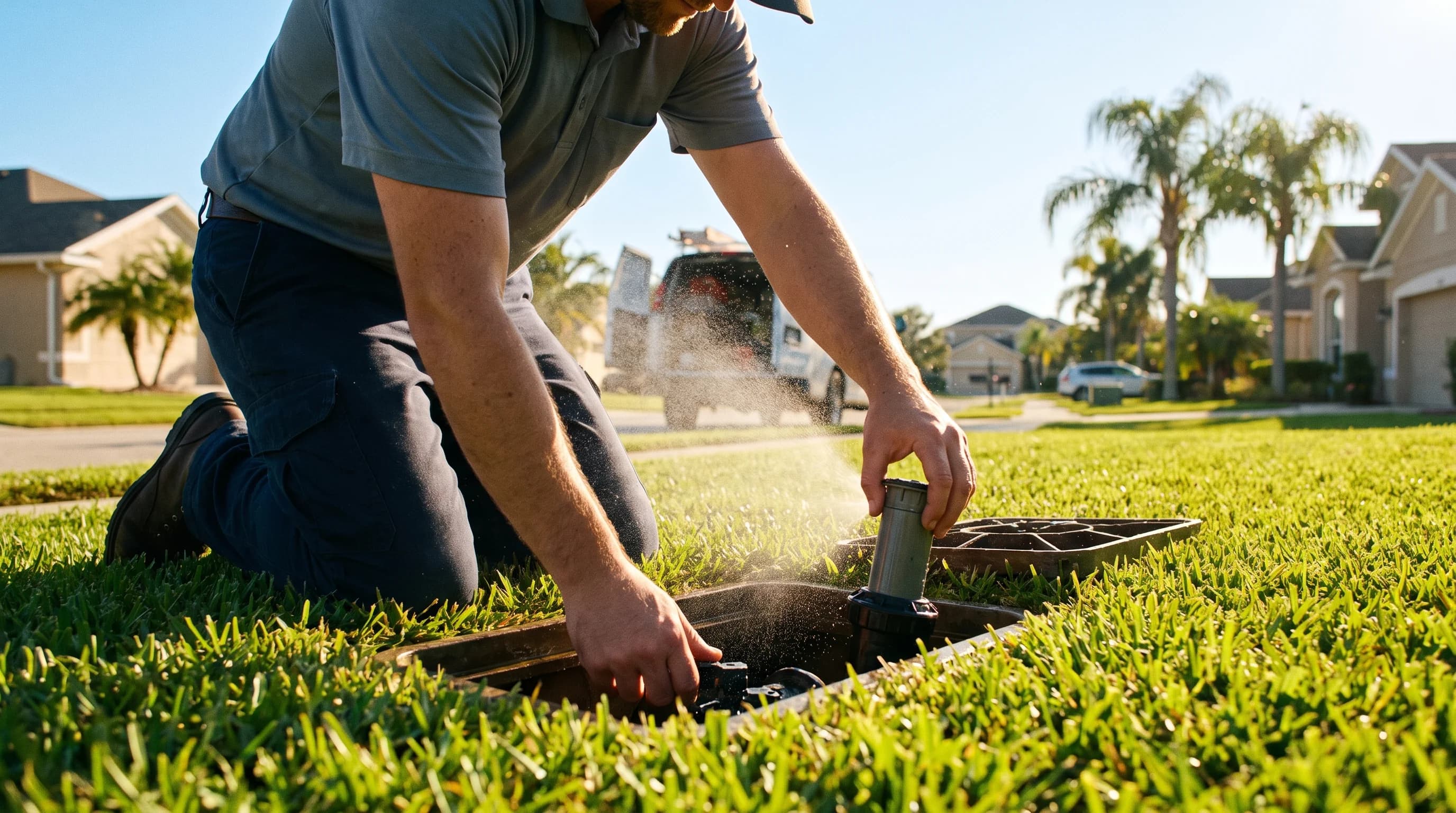
It is the first genuinely brutal week of July. A homeowner walks out at 6 a.m. to beat the heat and finds a small geyser where their zone-three head used to be, water sheeting across the driveway, and a sinking feeling about next month's utility bill. They pull out their phone, type "sprinkler repair near me," and start calling. Whoever picks up first, or texts back within a minute, is getting that job. Everyone else is getting voicemail they will never return.
That is the entire game with sprinkler repair leads. The buyer is not comparison shopping for weeks. They have a problem right now, they are standing in a wet yard, and they will hire the first competent-looking company that responds. This post is about how to be that company: how to get found for the urgent search, and how to stop losing the lead in the ten seconds after your phone rings.
Why sprinkler repair leads are different from other work
Most marketing advice treats all irrigation work the same. It is not. An install or a system-design job is a planned, budgeted, weeks-long decision. A repair is a fire. The homeowner is watching water run, worrying about the bill, and in many neighborhoods, worrying about a watering-restriction fine or an HOA letter.
That urgency changes everything about how you win the lead:
- The search is short and local: "sprinkler repair near me," "sprinkler head replacement [town]," "irrigation leak repair."
- The decision window is minutes, not days.
- The buyer rarely leaves a voicemail. They call down the list until a human answers.
So the two things that actually get you sprinkler repair leads are (1) showing up in that first handful of local results, and (2) answering when the phone rings. Almost everything else is a distraction until those two are solid.
There is real volume behind these searches, and it is not going away. The EPA notes that landscape irrigation accounts for nearly one-third of all residential water use in the U.S. - roughly 9 billion gallons a day, and that a large share of it is wasted through inefficient and leaking systems. Every one of those leaks is eventually a repair call. Your job is to be the business that call reaches.
Build the service-area engine that gets you found
You cannot answer a call you never got. Before anything else, make sure your business is one of the names that appears when someone in your service area searches.
Your Google Business Profile is the front door
For hyper-local, high-urgency searches, your Google Business Profile does more work than your website. It is what populates the map pack - the little block of three businesses with stars and phone numbers that sits above the regular results on a phone.
Get the fundamentals right:
- List your accurate service areas, not a fake storefront address. Google lets service-area businesses show the regions they cover instead of a physical location, which is exactly how a mobile repair crew should be set up.
- Add real photos of your crew, trucks, and finished repairs. Not stock images.
- Keep hours accurate and turn on messaging if you can staff it.
- Reply to every review, good or bad. Recent, answered reviews signal to both Google and the homeowner that you show up and fix things.
Reviews matter more here than in almost any other trade, because the buyer is nervous and deciding fast. A steady stream of recent five-star reviews that mention "came out same day" or "fixed the leak in an hour" does your selling before you ever speak.
Service pages that match the exact search
A single "services" page will not rank for the specific problems people type. Build a dedicated page for sprinkler repair that names the failures you fix: broken or clogged heads, cracked lines, leaking or stuck valves, wiring and controller faults, low pressure, and backflow issues.
Then layer in place. A page that says "sprinkler repair in [your town]" and honestly describes the neighborhoods you cover will pull in searches a generic page never touches. Sprinkler repair is hyper-local; the homeowner wants someone who clearly works their street, not a company two counties over.
Local Services Ads for the top of the page
When you want to buy your way to the very top for repair searches, Google's Local Services Ads are built for it. You appear above the regular ads, you are marked as a screened provider, and you pay per lead rather than per click. For an emergency category like sprinkler repair, paying only when an actual customer contacts you is a sensible way to catch the overflow you cannot reach through organic search alone.
If you want the full picture of how paid and organic local channels fit together for outdoor service businesses, our breakdown of a complete growth system for irrigation companies walks through where each channel earns its keep.
The Florida angle: year-round demand and watering rules
In Central Florida, irrigation is not a spring-through-fall business the way it is up north. Systems run close to year-round, which means failures happen year-round and repair demand almost never stops.
Two local realities work in your favor if you build content and promotions around them:
- Watering restrictions. Florida's water management districts set specific allowed watering days and times, and they change with the seasons. The St. Johns River Water Management District, for example, publishes a year-round landscape irrigation schedule that homeowners are expected to follow. A system stuck running on the wrong day is both a fine risk and a repair call. Content that explains the local rules positions you as the expert who keeps them compliant.
- Smart Irrigation Month. July is Smart Irrigation Month, an industry initiative from the Irrigation Association focused on water-efficient systems. It is a ready-made, credible hook for a mid-summer promotion on controller upgrades, leak checks, and efficiency tune-ups - the exact services that turn a one-time repair into a bigger ticket.
Lean into the calendar. When systems are running hardest and water bills are highest, the homeowner is most motivated to fix the leak and most receptive to an efficiency upgrade.
Where most sprinkler repair leads actually die
Here is the uncomfortable part. Most owners chasing more sprinkler repair leads do not have a traffic problem. They have a capture problem. The searches are happening, the phone is ringing, and the calls are going to voicemail because the owner and the crew are elbow-deep in valve boxes all day.
For an emergency buyer, voicemail is a dead end. They do not wait. Think about your own behavior when something breaks at home: you call the first number, and if nobody answers, you are already dialing the second before the voicemail beep finishes.
The research on lead response backs up the instinct. A widely cited Harvard Business Review study on responding to online leads found that firms attempting contact within an hour were dramatically more likely to have a real conversation than those that waited, yet the average company took far longer to respond at all. For sprinkler repair, the window is even tighter than an hour - it is minutes.
You do not fix this by hiring a full-time receptionist. You fix it with a simple capture system:
- A live answer when it is humanly possible, because a real voice still books the most jobs.
- An automatic text back the instant a call goes unanswered, so the caller gets a human-sounding "Saw your call, what's going on with your system?" within seconds instead of dead air.
- One inbox a real person watches, so the text reply does not sit for six hours.
- A same-day follow-up habit, every time, no exceptions.
That capture layer is the difference between generating leads and banking jobs. Building the follow-up so your crew does not have to think about it is the core of our growth system for outdoor service businesses - the marketing gets the phone to ring, and the system makes sure a ringing phone becomes a booked repair.
Turn one repair into recurring revenue
A repair call is the cheapest customer you will ever meet, because they already have a problem and already picked you. The mistake is treating it as a one-off. The homeowner with a broken head this week has an aging system that will fail again, needs seasonal checks, and is a candidate for an efficiency upgrade.
Offer a simple maintenance or seasonal tune-up plan at the end of every repair. You already earned the trust and you are already standing in their yard. One recovered repair lead that becomes a recurring maintenance customer is worth many times the first invoice, and it smooths out the feast-or-famine swings that make this business stressful.
If you want to see how repair, maintenance, and upgrade work stack into predictable revenue, our transparent pricing and packages lay out how the pieces fit without the guesswork.
Your sprinkler repair lead checklist for this week
You do not need a six-month plan. You need a few concrete moves before Friday:
- Fix your Google Business Profile today. Set accurate service areas, add ten real photos, and reply to every review you have ignored.
- Build or sharpen one sprinkler repair page that names the exact problems you fix and the towns you cover.
- Turn on missed-call text back so no unanswered call dies in voicemail, and point the replies at one inbox someone actually watches.
- Add one line to every repair visit: offer the seasonal tune-up before you leave the driveway.
Do those four and you will get found for the urgent search, catch the leads you were quietly losing, and start turning single repairs into customers who call you first every season. When you are ready to wire that into a system built for the way irrigation companies actually work, a growth partner for irrigation and outdoor service businesses is what turns caught calls into a full schedule.