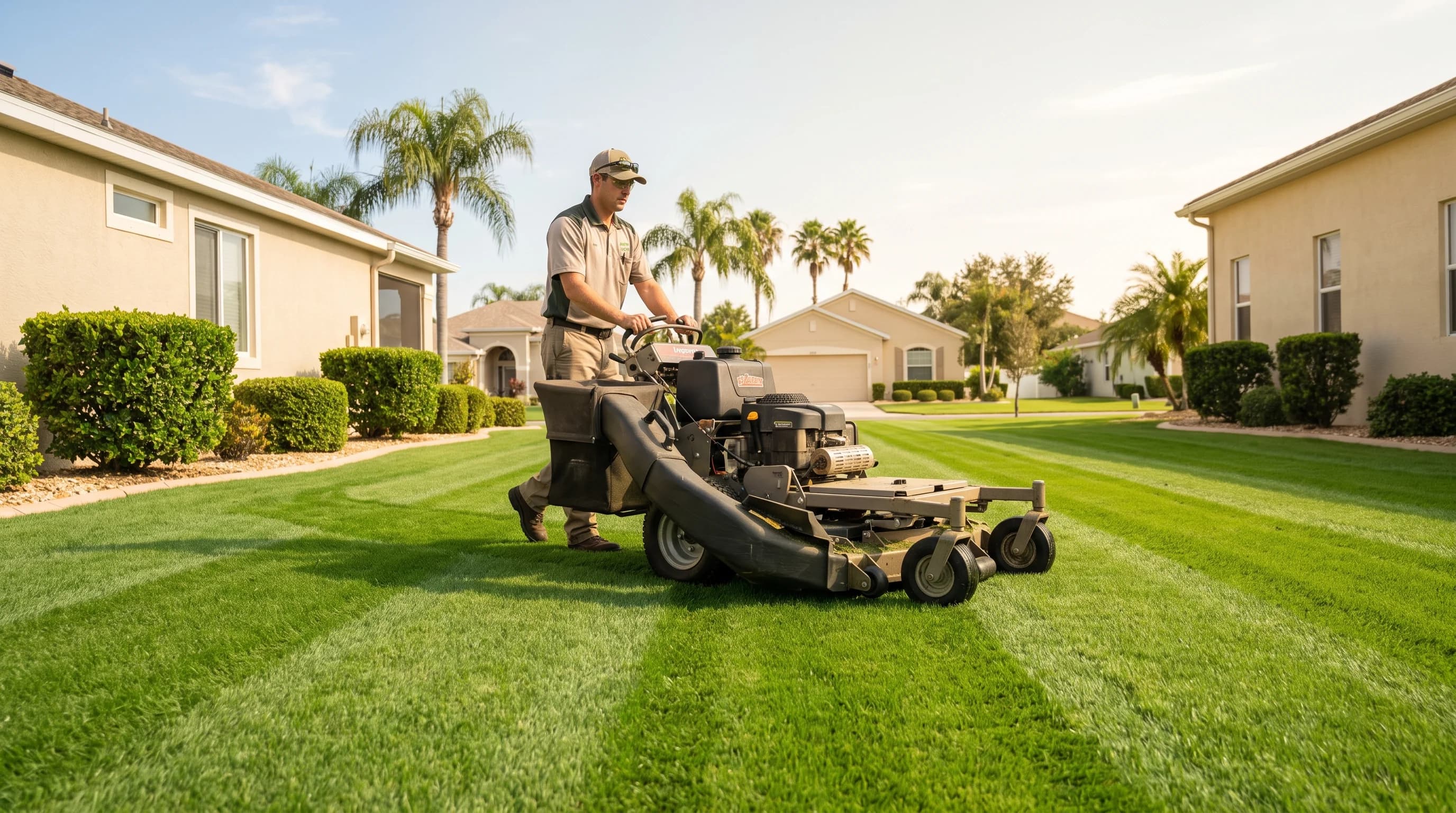
A single lawn care customer is not a $60 sale. Mow one yard on a weekly cycle through a full growing season, and even at the low end of the industry range - roughly $50 to $250 a visit depending on lot size and services - that one account is worth a few thousand dollars a year. Keep them three or four seasons and it is a five-figure relationship. In Central Florida, where grass grows close to year-round, the math is even friendlier.
So the honest question is not really how to get lawn care customers. Anyone can hand out flyers and win a few one-time cuts. The question is how to get customers who stay, sitting close enough together that your drive time does not eat the profit. Get that right and the same amount of marketing builds a much bigger business.
Get found where ready-to-buy customers actually search
Most homeowners do not plan their lawn care search. They notice the yard has gotten away from them, or a new neighbor's lawn looks sharp, and they pull out a phone and search "lawn care near me" or "lawn mowing service [their town]." Whoever shows up first in the map results and looks trustworthy gets the call.
That makes your Google Business Profile the single most valuable piece of free real estate you own. It is what puts you in the local map pack, and Google's own guide to adding and editing your Business Profile walks through the setup. Do not treat it as a one-time chore:
- Set an accurate service area covering the neighborhoods you actually want to work, not the whole metro.
- Add real photos of your crew and finished lawns, and refresh them through the season.
- Pick the right primary category (Lawn Care Service) and list your real services.
- Reply to every review, good or bad, so the profile looks alive.
Reviews do heavy lifting here, and not just for ranking. In BrightLocal's 2024 Local Consumer Review Survey, the overwhelming majority of consumers reported reading online reviews before choosing a local business. A steady stream of recent, specific reviews is often the tiebreaker between you and the company listed right above you.
If you want to rank for the exact phrases buyers type, a simple website with a page for each core service - weekly mowing, edging and cleanup, fertilization, seasonal work - and the towns you cover will pull in far more specific searches than a single generic homepage.
Turn your best customers into your sales force
The cheapest lawn care customer you will ever get lives next door to one you already have. You are already on that street. Servicing the house next door adds almost no drive time, which means it is pure margin.
That is why referrals and neighbor outreach beat almost every paid channel for this business. A few concrete moves:
- Ask directly, every time you finish a great job. "If a neighbor asks who does your yard, I would love the introduction." Most owners never actually say the words.
- Knock the two houses on either side of a lawn you just made look great. The proof is right there in front of them.
- Run a simple referral offer. A free cut or a month's discount for any customer who sends you a neighbor who signs up. Keep it dead simple so people remember it.
- Leave a clean door hanger on the block you are already working, with a real price range so people can self-qualify.
None of this requires an ad budget. It requires you to be systematic about the customers and streets you already touch. Referral and neighbor-cluster growth is also how you build the tight routes that make a lawn care business genuinely profitable instead of just busy.
Answer faster than the other three companies
Here is where most lawn care businesses quietly bleed. The marketing works, the phone rings, and the call goes to voicemail because the owner is on a mower with ear protection on. The homeowner does not leave a message. They just call the next company on the list.
The buyer is rarely loyal at this stage. They have three tabs open and they are dialing down the list. Speed of response, not polish, decides who books the job. You do not fix this by hiring a receptionist you cannot afford. You fix it with a simple capture habit:
- Answer live whenever you humanly can, because a real voice still books the most work.
- Turn on an automatic text back so any missed call gets an instant "Saw your call - what does your yard need?" instead of dead air. We break down why that one automation pays for itself in our guide to missed-call text back for contractors.
- Route every inquiry to one inbox a real person checks, so nothing sits for hours.
- Follow up the same day, every time.
Getting the phone to ring is marketing. Making sure a ringing phone becomes a booked, recurring account is a system, and it is the part most owners skip. Building that capture-and-follow-up layer so it runs without you thinking about it is the core of our growth system for landscaping and lawn care businesses - the marketing fills the pipeline, and the system makes sure the leads do not leak out the bottom.
Convert one-time jobs into accounts that renew
A one-time cleanup or a "can you just mow it this once" call is not a small job. It is an audition. That homeowner has a lawn that will need cutting again next week and every week after, and they have already let you onto the property.
Never leave a one-off without offering the recurring plan. Before you pull out of the driveway: "Want me to just put you on the weekly route so you never have to think about it again?" Frame it as one less thing they have to manage. A signed weekly account is worth many multiples of the single cut, and it is the difference between hustling for new work every Monday and running a predictable, scheduled business.
The same logic runs upward. A reliable mowing customer is the natural buyer for fertilization, seasonal cleanups, mulch, and eventually design and install work at much higher tickets. Owning the weekly relationship is what earns you those jobs later. If you want to see how recurring maintenance, add-on services, and bigger projects stack into predictable monthly revenue, our transparent pricing and packages lay out how the pieces fit.
So where should you start?
The right first move depends on where you are:
- If you are brand new and have almost no customers, start with density and reputation. Claim and fill out your Google Business Profile, get your first handful of customers to leave reviews, and knock the neighbors of every lawn you win. Cheap, local, and it builds a tight route from day one.
- If your phone already rings but the schedule is lumpy, your leak is capture, not marketing. Turn on missed-call text back, commit to same-day follow-up, and offer the weekly plan on every one-time job before you leave the driveway.
- If you are steady but stuck at your own capacity, the constraint is systems, not effort. That is when a growth partner for landscaping and lawn care companies earns its keep by wiring the whole pipeline together so you can grow the route without living on the phone.
Getting lawn care customers is not the hard part. Getting the ones who stay, keeping them clustered, and never letting a ringing phone die in voicemail - that is what turns a truck and a mower into a business you can actually plan around.