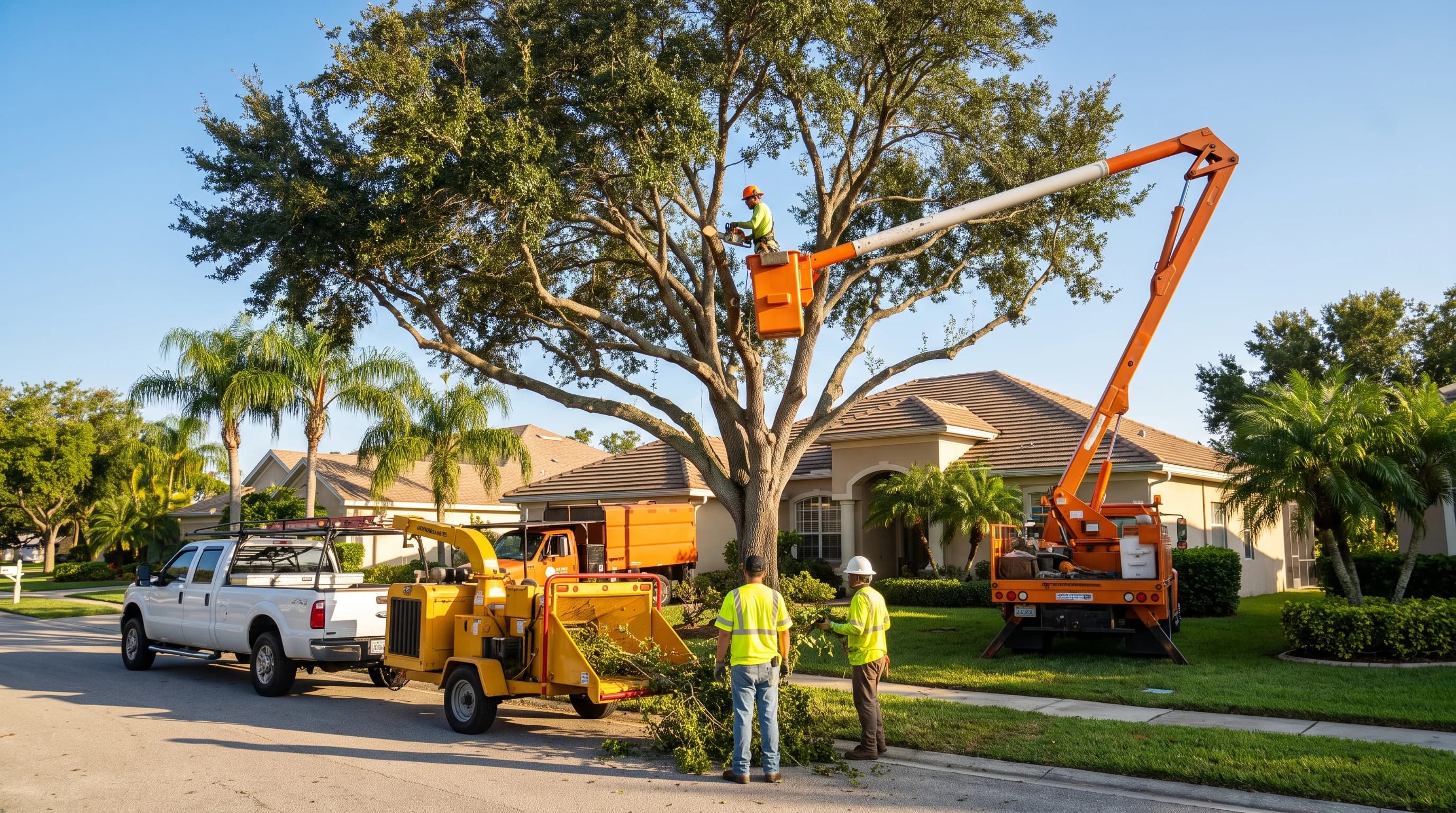
Most tree companies turn on Google Ads for tree service before the account is built to sell tree work. They pick a few keywords, point everything at the homepage, set a daily budget, and wait. Two weeks later the budget is gone, the clicks are up, and the phone rang maybe twice. The conclusion is almost always wrong: "Google Ads does not work for us."
It works. What does not work is running a high-ticket, emergency-heavy trade through a generic campaign built for nobody in particular. Tree work sells in a specific way, and the account has to match. This post walks through how to structure Google Ads for tree service so the money buys booked removals instead of curiosity clicks.
Google Ads and Local Services Ads are not the same channel
Before you spend a dollar, know which Google product you are actually buying. Local Services Ads sit at the very top with a verified badge and charge you per lead, only when a real person calls or messages. Google Ads are the pay-per-click search ads below them, where you control the keywords, the ad copy, and the page the click lands on. Google even asks you to choose the right campaign type before you build anything, and the type you want here is a Search campaign.
Most tree companies should run both, but they are billed and built differently. If you have not set up the pay-per-lead side yet, start with our Local Services Ads playbook for tree service. The rest of this post is about the pay-per-click Search side, where the biggest wins and the biggest leaks both live.
Structure the account around how tree work actually sells
The single most common mistake is one campaign with every keyword thrown in together. Tree work splits cleanly into two buyer types, and they behave nothing alike:
- Emergency work. A limb is on the roof, a trunk is leaning over the driveway, a storm just came through. This buyer wants someone today and will call the first credible company that answers. High intent, high urgency, willing to pay.
- Planned work. A homeowner is finally dealing with that dead oak or wants three trees trimmed before summer. They will get two or three quotes and take a week to decide. Same trade, completely different pace.
Build at least two Search campaigns so you can set budgets and bids for each. During Atlantic hurricane season, which the National Hurricane Center runs from June 1 to November 30, you can pour budget into the emergency campaign when storms are in the forecast and pull back when they are not. Try to run both buyer types through one campaign and the emergency urgency gets averaged away.
Bid on buying intent, not on trees
The keyword list is where budgets quietly bleed. You want terms that mean "I am ready to hire," not "I am curious about trees." Group your keywords around real services and your service area:
- Emergency: emergency tree removal, storm damage tree removal, fallen tree removal, tree on house
- Planned: tree removal near me, tree trimming service, stump grinding, tree service [your city]
Just as important is telling Google what to ignore. Broad and phrase match will pull in searches you never want to pay for. Google lets you add negative keywords to block them, and every tree service account should start with a list like this: free, DIY, how to, jobs, hiring, salary, rental, for sale, wood, mulch, and the names of any tree species people search out of pure curiosity.
Match types matter too. Broad match reaches the most people and wastes the most money without tight negatives. Read Google's guide to keyword matching options and lean on phrase and exact match while you are learning what converts, then loosen up once your negative list is doing its job.
Make the ad and the phone the whole point
Tree work is a phone business. The homeowner with a branch through the garage is not filling out a contact form, they are calling. So the ad and everything attached to it should push the call.
Write ads that name the exact service and the urgency: "Emergency Tree Removal - Same-Day Crews" beats "Quality Tree Care Since 2004." Add your city so the searcher knows you are local. Turn on call assets and, for the emergency campaign especially, run ads that let someone tap straight to a call from their phone during the hours you can actually answer.
That last part is not a detail. If your ads run at 9 p.m. during storm season but the call goes to voicemail, you paid for the click and handed the job to whoever picked up. This is exactly where fast response and missed-call recovery earn their keep, the same speed-to-lead discipline that wins home service jobs applies to every paid click you buy.
The landing page decides whether the click pays off
Clicks with no calls is the most common complaint, and the cause is almost always the page after the click. Sending paid traffic to a slow, generic homepage is like running a great ad and then hiding your phone number.
The page a tree service ad points to should do four things fast:
- Load in a couple of seconds on a phone, because that is where the click came from.
- Put a tap-to-call button and your phone number at the very top, above everything else.
- Match the ad. If the ad said emergency tree removal, the headline should say emergency tree removal, not "Welcome to our website."
- Show proof: real reviews, real photos of finished jobs, license and insurance, and your service area.
Google rewards this too. A relevant, fast, useful page raises your Quality Score, which lowers what you pay per click. So the page that converts better also costs you less to send traffic to. If your current site is not built to do this, a growth system built for tree service companies puts the campaign, the landing page, and the follow-up on the same rails instead of leaving them to fight each other.
Read three numbers, not one
"Is Google Ads working?" is the wrong question because it hides where the problem is. Read three numbers instead:
- Cost per click. What you pay to get someone to the page.
- Cost per lead. What you pay per actual call or form fill. If clicks are cheap but leads are expensive, the page or the offer is the problem.
- Cost per booked job. What you pay per job you actually win. If leads are cheap but jobs are not, the problem is how fast you answer and follow up, not the ads.
Only the third number tells you whether the channel makes money. To see it, you have to connect the calls your ads produce to the jobs you close, which means tracking every channel rather than guessing. Owning that full pipeline, from the click to the booked pour, is the point of a complete growth system that captures and follows up on every lead, and the transparent pricing packages show what a full setup runs.
Set this up this week
You do not need a perfect account to start winning. You need a clean one. Before Friday:
- Split your campaigns. One for emergency work, one for planned work, each with its own budget. Stop averaging urgent buyers in with the slow ones.
- Load your negative keywords. Start with free, DIY, jobs, salary, wood, and rental, and add to the list every week as you read the search terms report.
- Fix the landing page. Tap-to-call at the top, real reviews and job photos, and a headline that matches the ad. Time how long it takes to load on your own phone.
- Turn on call tracking. Put a trackable number on the ads so you can connect clicks to booked jobs and see your real cost per job, not just your cost per click.
Do those four and you will already be ahead of most competitors, who are still pointing broad-match keywords at a homepage and wondering where the money went. Google Ads for tree service does work. It just rewards the company that built the account to sell tree work, and answers the phone when it rings.