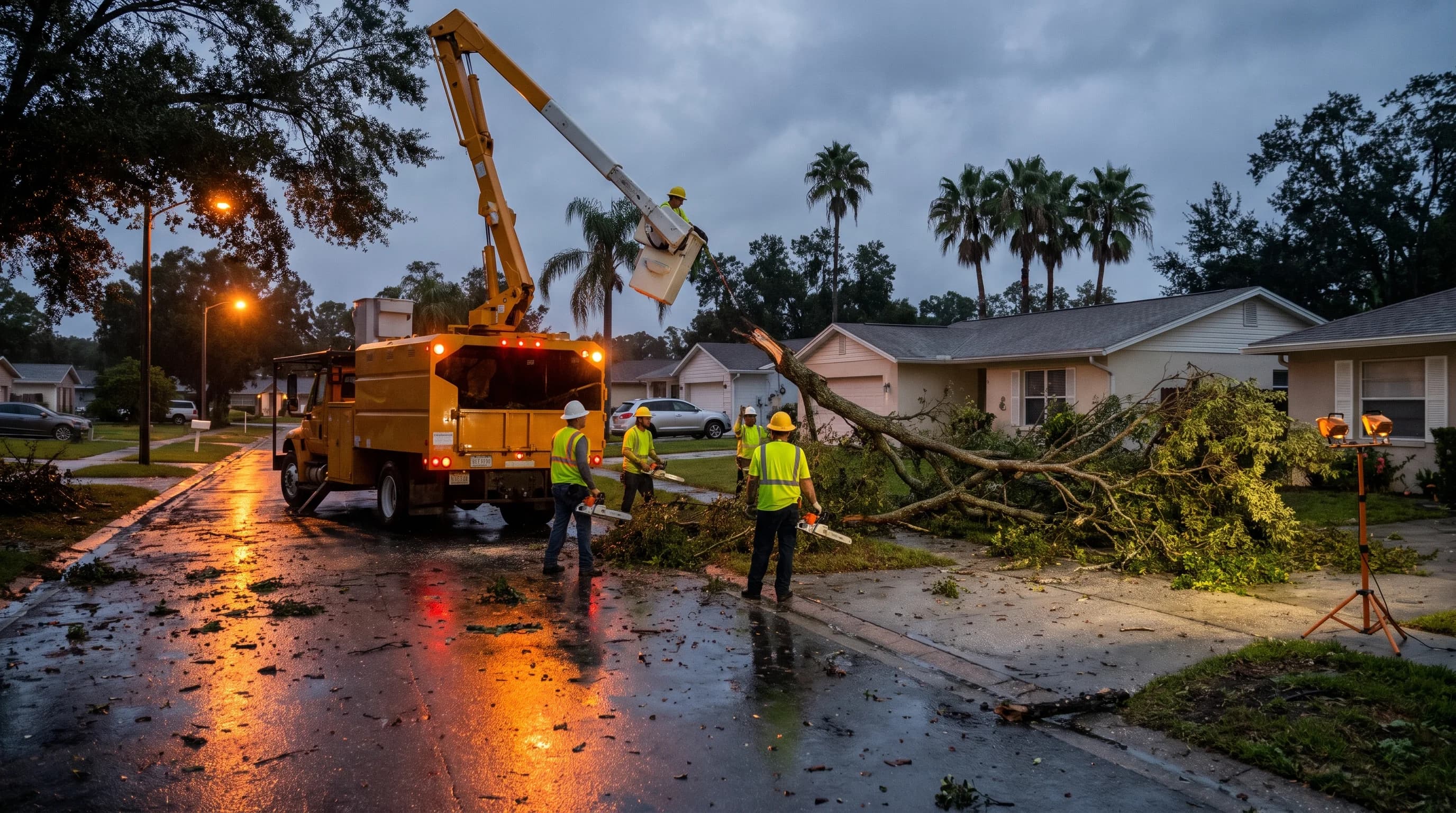
It is 9 p.m. in the middle of hurricane season and a limb has just come through a homeowner's roof two towns over. They grab their phone, thumb in "emergency tree removal near me," and tap the very first thing they see. That first result is not the map. It is not a website. It is a Local Services Ad with a review score, a green check, and a call button.
Whoever owns that spot gets the call. Everyone else finds out about the job when they drive past the cleanup the next morning.
That is the whole case for Google Local Services Ads for tree service companies. They put you above the map pack and above the regular text ads, on a pay-per-lead deal that only charges you when a real person reaches out. This guide walks through how the model works, what changed with the badge in late 2025, and how to set it up without lighting money on fire.
What Local Services Ads actually are
Local Services Ads (LSA) are a separate Google product from the regular Google Ads you may already run. They show up in their own block at the very top of the search results, above both the map pack and the text ads, for service searches like "tree removal" or "emergency tree service near me."
Each ad shows your business name, your review star rating, your city, your hours, and a badge. A homeowner taps to call you or send a message request, and per Google's own Local Services Ads documentation, from that first contact "the lead is yours to turn into a customer."
The part that matters most for a tree service: you pay per lead, not per click. Google says you "pay only for leads related to your business and the services you offer." Somebody who calls about a service you do not do, or from outside your service area, is a lead you can dispute rather than eat.
That billing model is the opposite of regular search ads, where you pay every time a curious clicker taps your headline and bounces. For a trade where a single removal can run $1,000 to $8,000 or more, paying only when the phone actually rings changes the math in your favor.
Why LSA fits tree work so well
Not every trade gets equal value from Local Services Ads. Tree service happens to be close to a best case, for three reasons.
The jobs are high ticket. When one recovered call can be a four-figure removal, you can absorb a higher cost per lead than a business selling $80 tune-ups ever could. The break-even is generous.
A lot of the work is urgent. Storm damage, a leaning trunk over a driveway, a cracked limb after a windy night - these are searched and booked the same day. Urgent searchers do not scroll. They tap the top result, which is exactly where LSA sits.
Florida hands you a season. The Atlantic hurricane season runs June 1 to November 30, with peak activity around September 10, according to NOAA's National Hurricane Center. Central Florida crews live through a predictable spike in emergency demand, and the companies visible at the top when a storm rolls through are the ones that book the cleanup.
The badge changed in late 2025 - here is the truth
If you researched Local Services Ads a couple of years ago, you probably read about the "Google Guaranteed" badge and a money-back guarantee for homeowners. That is out of date, and getting this wrong in your own marketing looks amateur.
According to Google's own announcement of the Local Services Ads badge changes, on October 20, 2025 Google consolidated the old "Google Guaranteed," "Google Screened," and "License Verified by Google" badges into a single Google Verified badge. At the same time, Google discontinued the consumer money-back guarantee that used to accompany Google Guaranteed.
What that means in plain terms:
- The badge still tells homeowners that Google screened your business, including license, insurance, and background checks.
- Google no longer reimburses a homeowner up to a set amount if a job goes wrong. That safety net is gone.
- Existing advertisers who had completed verification kept the badge automatically, with no action needed.
The badge is still worth earning. A verified badge next to your star rating is a trust signal a cold website cannot match. Just do not promise customers a "Google guarantee" that no longer exists, and update any old truck wrap, flyer, or web page that still uses the retired wording.
What it costs, and how you are billed
There is no single price. You set a weekly budget, and Google spends it acquiring leads for you at a cost per lead that depends on your market, your competition, and the type of work.
Any specific dollar figure you see quoted online should be treated as illustrative, not a quote for your zip code. As an illustrative example, an emergency storm-damage lead in a dense, competitive metro will cost more than a planned-trimming lead in a quieter market, because intent and competition are both higher. The only number that matters is the one your own account reports once you are live.
Two features protect your spend:
- You pay per lead, not per click. A tire-kicker who taps and leaves costs you nothing.
- You can dispute junk leads. Wrong service, wrong area, spam, or an obvious misdial can be flagged for credit, so you are not paying for calls that were never real jobs.
The honest way to judge LSA is the same way you judge every channel: cost per booked job against your average ticket. A lead price that looks high is still cheap if those leads are four-figure removals that close. We wrote a full breakdown of how to size that spend in our guide to what a tree service should budget for marketing.
How Google decides who shows up
You do not simply buy the top LSA spot. Google ranks advertisers, and for a tree service the biggest levers are:
- Reviews. Your Local Services rating and the number of reviews weigh heavily. A steady flow of recent five-star reviews lifts you.
- Responsiveness. Google states plainly that if you "regularly fail to answer calls or respond to messages, your ad ranking may be affected." Missed calls do not just cost you that job - they cost you future visibility.
- Proximity. How close your business is to the searcher.
- Being open now. Businesses open at the moment of the search can surface for urgent queries, which is why after-hours availability matters during storm season.
Notice that two of the four levers - reviews and responsiveness - are things you control on the ground, not settings in an ad account. That is good news. It means the same habits that build a healthy business also lift your ads.
Setting up LSA for your tree service
The setup is more paperwork than the ad itself. Budget a week or two, because verification is not instant.
- Confirm eligibility and licensing. Tree service licensing rules vary by state and locality. Have your business license, any required arborist or contractor credentials, and proof of insurance ready before you start.
- Create the Local Services Ads profile. Set your business name, service areas, hours, and your primary category as Tree Service, with the specific job types you want leads for.
- Complete verification. Google screens your license, insurance, and background to grant the Google Verified badge. Submit clean, current documents to avoid delays.
- Set a weekly budget. Start at a level tied to how many jobs you can actually handle, then adjust as real cost-per-lead data comes in.
- Wire up fast response. Decide who answers LSA calls and messages, and how quickly, before the first lead lands.
That last step is where most of the money is won or lost.
The mistake that quietly wastes LSA money
Owners obsess over budget and bid, then let leads sit. A lead that calls at 8:12 and gets a callback at 5 p.m. is usually already someone else's job. In urgent tree work, the first company to answer a live person tends to win, and the ad you paid for is wasted if nobody picks up.
This is exactly the gap a real system closes. Missed-call text-back, a shared inbox for LSA messages, and a simple rule that every lead gets a human within minutes will do more for your return than any bid tweak. Turning fast, reliable follow-up into a system your crew does not have to think about is the heart of our growth system for tree service companies, and it is the difference between paying for leads and actually booking them.
LSA is one channel, not the whole plan
Local Services Ads are one of the strongest single moves a tree service can make, but they are not a strategy by themselves. They sit on top of a foundation: an accurate Google Business Profile, real reviews, a website that turns a click into a call, and follow-up that never lets a quote go cold.
Run LSA without that foundation and you will pay for leads your business is not set up to convert. Build the foundation first, then let LSA pour high-intent calls into a machine that reliably closes them. If you want to see how the pieces fit from foundation to scale, our transparent pricing and packages lay out what that full system looks like before you commit to anything.
Your LSA setup checklist for this week
You do not need a marketing degree to get moving. Before Friday:
- Gather your business license, insurance certificate, and any arborist or contractor credentials in one folder so verification does not stall.
- Create your Local Services Ads profile with Tree Service as the primary category and your real service areas and hours.
- Write down who answers LSA calls and messages, and set the expectation that every lead gets a human within five minutes.
- Ask your last five happy customers for a Google review today, because your rating is a ranking factor from day one.
Do those four things and you will be verified, visible, and ready before the next storm sends someone searching. When you are ready to turn those calls into a booked schedule instead of a pile of voicemails, a marketing partner built for tree service companies is exactly what that takes.